Travel Tips · Rail
Interrail Guide: How It Works, What It Costs and Routes Worth Taking
A rail pass can take you across Europe. It cannot give you back a day spent rushing through a city with your suitcase. Here is how to choose the right Interrail Pass, build a sensible route and work out whether the numbers really add up.
Published by Destination Finder · Rules and routes checked 11 November 2026
Quick summary
- What is Interrail? One pass for travel on participating rail networks across 33 European countries, with Global and One Country options.
- Who can use it? Travellers worldwide. Eurail became part of Interrail on 9 September 2026; older advice saying non-Europeans must buy Eurail is out of date.
- Which pass works for two weeks? A four- or five-day flexible Global Pass can suit a trip with four intercity train days. Count the trains you will board on different dates, not the number of nights away.
- What is extra? Reservations on many high-speed and night trains, accommodation, city transport, food and activities. A pass is not an all-inclusive ticket.
- Is it cheaper? Sometimes. Compare the pass plus reservations against actual point-to-point fares for your dates before buying.
- Best beginner strategy: Choose three to five bases, book the trains with compulsory reservations first, and leave room to stay somewhere longer.
Rail rules and routes checked: 11 November 2026. Example budgets are planning models, not live travel quotations.
A map makes Amsterdam, Berlin and Prague look like three neat dots. A station departure board is less sentimental. There are departure times to meet, platforms to find, reservations to remember and, occasionally, an entire afternoon that disappears into a change of trains.
That is not an argument against Interrail. It is an argument for using it well.
An Interrail Pass can make a European rail trip pleasantly flexible: one ticket for an extensive network rather than a separate purchase for every journey. But it does not make every train free, every connection convenient or every ambitious itinerary wise. The real skill is knowing which days to move—and which days to remain exactly where you are.
What Is Interrail and How Does It Work?
An Interrail Pass gives its holder access to participating trains in the countries covered by that pass. The Global Pass covers participating services in 33 European countries; a One Country Pass focuses on a chosen country or designated area. Some ferries and other transport services are included or discounted, but urban metro, tram and bus journeys generally require separate tickets. A pass also does not guarantee a seat on trains with mandatory reservations. See the official Interrail overview.
Who is eligible? Interrail versus Eurail in 2026
This is one area where old blog posts can mislead. Interrail once served European residents while Eurail was the equivalent brand for travellers living outside Europe. On 9 September 2026, the two became one Interrail brand. Travellers worldwide now buy an Interrail Pass; previously issued Eurail Passes remain valid under their original terms. The official announcement explains the change.
Your country of residence still matters. Travellers whose home country is within the Interrail network face limits on using a Global Pass there: generally one outbound and one inbound journey during the pass's travel days. A One Country Pass cannot be purchased for travel in your country of residence, and it does not cover the journey from another country into the pass country. Read the residency rules before planning a long domestic leg.
The travel-day rule, without the jargon
A travel day is a calendar day, from 00:00 to 23:59 local time, when a valid pass lets you board participating trains. Take one train or five: it still counts as one travel day. Time zones matter when crossing borders. A flexible pass gives you a set number of travel days within a wider validity window; a continuous pass makes every day in its validity period available for rail travel. Interrail sets out the details in its travel-day guide.
Consider a 14-day trip: Amsterdam for three nights, Berlin for three, Prague for two, Vienna for two and Budapest for three. It takes four travel days to connect those five cities. A five-day flexible Global Pass leaves one extra day for an eligible outbound or inbound journey, an excursion, or a change of plan. It does not buy a return journey home if that journey falls outside the pass's validity or rules.
One detail worth remembering: board a direct night train before midnight and, provided you do not change trains after midnight, you generally use only the departure day's travel day. You still need any sleeper or seat reservation, and the overnight journey must fit the pass-validity rules. Change trains after midnight and a second travel day is needed.
The Rail Planner app: your pass is not your reservation
With a mobile pass, add the pass to the Rail Planner app, activate it for your trip, save journeys, and add each train you intend to take to your pass before boarding. The app displays the ticket for inspection. Interrail says the mobile pass needs an internet connection at least once every three days; check your phone's battery and app updates before a long journey. Full instructions are on the mobile-pass page.
Saving a route in the app is not the same thing as buying a seat reservation. When a specific train requires one, you must secure it separately and show both the reservation and your valid pass when requested.
Global Pass or One Country Pass?
| Global Pass | One Country Pass | |
|---|---|---|
| Geography | Participating services across 33 countries | Participating services in one specified country or a named regional pass area |
| Best for | A multi-country journey or flexible cross-border plans | A slower, deeper exploration of one country |
| Travel-day choice | Flexible or continuous options | Typically a specified number of travel days within a validity period; options vary by pass |
| Key restriction | Limited travel in your own country of residence, where applicable | Cannot be bought for your country of residence; does not cover getting to or from the pass country |
| Typical mistake | Paying for more travel days than you will use | Assuming it covers an international journey into the chosen country |
For a city-to-city route across Germany, Czechia and Austria, the Global Pass is the natural candidate. If the plan is two weeks tracing Italy from Turin to Naples, compare an Italy One Country Pass with separate tickets on the routes you actually need. The official pass selector is the place to confirm available combinations.
Do the unglamorous work first: mark each date on which you will take a pass-covered train. A day in Prague spent walking, eating and doing absolutely nothing to advance your itinerary is not a travel day. There is no prize for turning it into one.
How Much Does Interrail Really Cost?
The number on the pass checkout page is only the beginning. What matters is the complete trip budget—and, particularly, how often the route forces you onto trains with compulsory reservations.
Budget for seven separate things: the pass, reservations and supplements, accommodation, food, local transport, activities, and a contingency fund. Add any flights or point-to-point transport needed to reach the starting city or return home. Those access journeys are not included in the examples below.
A realistic 14-day planning exercise
These are illustrative per-person calculations, not quotes for particular dates or claims about current hostel or hotel rates. Both assume a second-class, five-travel-day Global Pass allowance of €250. That figure is a budget placeholder, not a verified current fare; replace it with the live price for your age and chosen pass. The models assume 14 days and 13 paid nights, travel in shoulder season, and four main city-to-city journeys, with a fifth travel day held in reserve.
| Expense | Budget traveller | Mid-range traveller |
|---|---|---|
| Five-day Global Pass allowance | €250 | €250 |
| Reservations and rail supplements allowance | €60 | €100 |
| Accommodation | 13 × €40 = €520 | 13 × €110 = €1,430 |
| Food | 14 × €25 = €350 | 14 × €50 = €700 |
| Local transport | €60 | €100 |
| Activities | €80 | €200 |
| Contingency | €100 | €150 |
| Illustrative trip total | €1,420 | €2,930 |
The budget model assumes a hostel dorm or similarly priced shared accommodation, simple meals and occasional paid attractions. The mid-range model assumes a private room priced per person, more restaurant meals and a larger leisure budget. In expensive cities or peak summer, either assumption may be optimistic. Neither includes shopping, travel insurance, visas, access flights or an extra night caused by disruption.
The lesson is less about the totals than their composition. In the first model, 13 nights of accommodation cost more than twice the pass allowance. Searching for a cheaper rail pass while ignoring where you sleep is rather like arguing about the price of mustard after ordering an expensive dinner.
What do seat reservations cost?
As a guide—not a promise of availability—Interrail currently advertises reservation prices from €10 for domestic high-speed trains, from €15 for international journeys and from €20 for night trains. Actual prices depend on route, train, date and accommodation type; some compulsory supplements are separate. Consult the official reservation guide before locking in your budget.
Seat Reservations and Easily Missed Extras

One of Interrail's most useful freedoms is the ability to choose another train when plans change. One of its least useful surprises is discovering that the next train is fully booked for pass holders.
Many TGV, Eurostar, AVE and other high-speed services, and night trains, require a reservation in addition to a valid pass. On plenty of regional trains, no reservation is required. Requirements differ even between services on the same corridor, so check the actual departure rather than relying on the general reputation of a country's rail network. The official seat-reservation guide explains the distinction.
Reservations can be made through Interrail's booking system, participating railway operators, and in some cases stations. The Interrail self-service system lists an administration charge of €2 per person per train, plus a possible €9 per order for paper tickets. Check the total at checkout; a national operator may offer a different booking route or price.
Check these three journeys especially carefully:
- Amsterdam–Paris: Eurostar is fast, but a pass-holder reservation is required. A full train is not a problem the pass can solve.
- Paris–Barcelona: the direct TGV takes roughly 6 hours 50 minutes in current schedules. Reservation availability deserves attention before you book non-refundable accommodation on either end. Check the SNCF timetable.
- Munich–Venice via the Brenner route: on relevant Railjet services crossing into Italy, Interrail lists a mandatory supplement; in second class the international supplement is currently €10, and a seat reservation may be extra. See the Brenner supplement rules.
Night trains deserve their own line in the budget. A standard seat may be cheaper than a couchette or sleeper, but a night's alleged accommodation saving is less persuasive after an uncomfortable night and a morning spent trying to feel human. Compare the full fare for the sleeping category you would actually book against a day train plus one night's lodging.
To reduce reservation fees, use Rail Planner's “No reservation needed” filter and compare slower regional trains. Sometimes this turns a two-hour journey into four hours with changes. Sometimes it takes you through a part of the country you would otherwise miss. It is a trade-off, not a universal bargain. Keep a connection buffer when changing trains, and verify timetables with the operating railway near departure.
Three Interrail Routes Worth Considering
1. Amsterdam → Berlin → Prague → Vienna → Budapest
Allow 12–16 days. Best for: a first multi-country trip that balances substantial cities with manageable railway days.
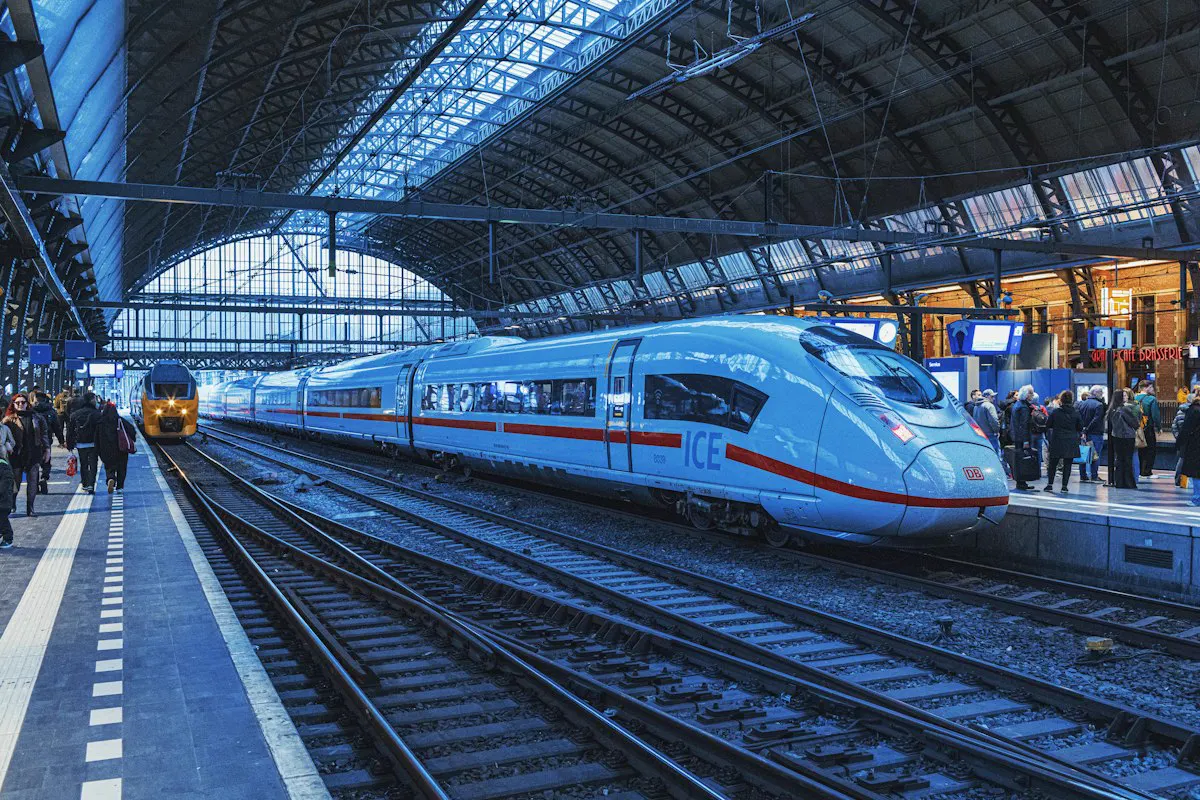
This route has an unusually satisfying logic: canals and brick warehouses in Amsterdam give way to Berlin's layered urban history, Prague's river and steep streets, Vienna's coffeehouse culture and Budapest's views across the Danube. No compulsory dawn-to-midnight sprint is needed to make the sequence work.
German and Central European operators offer the relevant connections: Amsterdam–Berlin in under six hours on direct services according to Deutsche Bahn, a direct Berlin–Prague corridor, Prague–Vienna around 4 hours 15 minutes, and Vienna–Budapest around 2 hours 40 minutes. Check the exact dates and reservation requirements; schedules are not timeless. Sources: Deutsche Bahn Netherlands services, Berlin–Prague route, and Deutsche Bahn's ÖBB connections FAQ.
Planning note: A four-day Global Pass can cover the four intercity travel dates; a fifth day buys a little more room for an eligible extra journey. Build in at least two nights per stop, and preferably three in Berlin and Budapest. If time is short, omit a city instead of visiting all five in a blur.
2. Amsterdam → Paris → Barcelona
Allow 8–12 days. Best for: travellers happy to reserve the major trains early and devote more time to three cities.
The first move, Amsterdam–Paris, takes roughly 3 hours 20 minutes on Eurostar. The second is a considerably longer passage: Paris–Barcelona, about 6 hours 50 minutes on direct TGV services in current SNCF schedules. One route runs through high-speed rail's clean, efficient geometry; the other earns its place with the shift from northern Europe toward the Mediterranean. Sources: Eurostar network figures and SNCF Paris–Barcelona timetable.
Planning note: Both principal train journeys require careful reservation checks, and fixed-price advance point-to-point tickets may beat a pass here. With only two intercity journeys, this is a route to price first, pass second. Leave room in Paris for an unplanned afternoon rather than treating the city as a station interchange.
3. Munich → Venice → Florence → Rome
Allow 10–14 days. Best for: architecture, art and food, with a striking Alpine crossing at the start.

From Munich, the line towards northern Italy crosses the Alps via Innsbruck and the Brenner corridor; connections and through-services vary by date, so check whether your chosen service continues to Venice or requires a change. From Venice to Florence, Trenitalia advertises direct Frecciarossa journeys of around 2 hours 13 minutes; Florence to Rome takes a little over 90 minutes on fast services. Sources: ÖBB Railjet network, Trenitalia Venice routes, and Trenitalia Florence–Rome.
Planning note: Italy is a country in which fast services and pass-holder reservations can add up. Remember the Brenner supplement. Compare a Global Pass with a combination of an ordinary Munich–Venice ticket and individual Italian tickets, particularly if your dates are firm.
Seven-, 14- and 21-Day Interrail Itineraries
These are sample pacing plans, not confirmed bookings. They assume arrival in the first city on day 1 and departure from the final city on the last day. The number of nights adds up to one fewer than the trip's calendar days. Check opening hours, events and train schedules for your own dates.
Seven days: three cities, no heroic detours
| Dates | Where to sleep | What the days are for |
|---|---|---|
| Days 1–2 | Amsterdam, 2 nights | Arrive, orient yourself, enjoy a full day without a suitcase |
| Days 3–4 | Berlin, 2 nights | Train day 3; one substantial sightseeing day |
| Days 5–6 | Prague, 2 nights | Train day 5; one full day in the city |
| Day 7 | Depart Prague | Allow time for onward travel; add a pass day if an eligible train journey is needed |
Intercity pass days: 2. A pass may not be the cheapest purchase for this short itinerary. Compare the two fares first. For a week, the itinerary's greatest luxury is not another country; it is the extra hour before checkout.
Fourteen days: the Central Europe classic
| Dates | Where to sleep | Train or stay? |
|---|---|---|
| Days 1–3 | Amsterdam, 3 nights | Stay |
| Days 4–6 | Berlin, 3 nights | Train day 4; stay days 5–6 |
| Days 7–8 | Prague, 2 nights | Train day 7; stay day 8 |
| Days 9–10 | Vienna, 2 nights | Train day 9; stay day 10 |
| Days 11–13 | Budapest, 3 nights | Train day 11; stay days 12–13 |
| Day 14 | Depart Budapest | Onward journey depends on your ticket and pass validity |
Intercity pass days: 4. The schedule offers the best of the route without pretending that every day needs a new postcode. It also gives you a full day in Prague and Vienna—less than either deserves, but substantially better than an afternoon and a postcard.
Twenty-one days: linger where it matters
| Dates | Where to sleep | Train or stay? |
|---|---|---|
| Days 1–3 | Amsterdam, 3 nights | Stay |
| Days 4–7 | Berlin, 4 nights | Train day 4; stay days 5–7 |
| Days 8–10 | Prague, 3 nights | Train day 8; stay days 9–10 |
| Days 11–14 | Vienna, 4 nights | Train day 11; stay days 12–14 |
| Days 15–20 | Budapest, 6 nights | Train day 15; day trips or slow days afterwards |
| Day 21 | Depart Budapest | Budget separately for your route home |
Intercity pass days: 4. With three weeks available, consider a day trip or two, but do not automatically upgrade to a longer continuous pass. A regional ticket for one excursion may cost less than an additional pass travel day. Six nights in Budapest are deliberate: a longer stay makes room for baths, neighbourhood walks and the ordinary rhythms that a succession of check-ins conceals.
Is Interrail Cheaper Than Regular Train Tickets?
There is no honest one-word answer. The pass is a flexibility product as well as a transport ticket. Whether it saves money depends on where you go, how far in advance you book, whether you qualify for a discounted pass, and the reservations your route requires.
For a simple decision, add up the cheapest suitable point-to-point fares for the trains you would actually take. Then add the price of your proposed pass, all compulsory reservations and supplements, and any domestic travel or access legs the pass will not cover.
The arithmetic can reverse depending on booking conditions. Imagine four trains:
| Illustrative comparison only | Separate train tickets | Pass plus reservations |
|---|---|---|
| Advance-purchase scenario | €35 + €45 + €25 + €20 = €125 | €250 pass allowance + €30 reservations = €280 |
| Short-notice scenario | €95 + €110 + €70 + €75 = €350 | €250 pass allowance + €30 reservations = €280 |
These ticket prices are deliberately hypothetical, not live fares. The point is the method: buying the same pass can look extravagant or sensible depending on the actual alternatives. Also compare changes and refund terms. A cheap non-flexible ticket is only cheap if you can use it.
As a rule of thumb:
- Consider a Global Pass for multiple longer journeys, plans that may change, or expensive late-booking routes with manageable reservation fees.
- Consider individual tickets for two or three journeys, a fixed itinerary booked well ahead, or a route dominated by high-speed services with substantial pass supplements.
- Consider a One Country Pass for repeated journeys inside one country, but calculate against domestic fares and any cheaper local rail products.
Common Interrail Mistakes to Avoid
- Mistaking a pass for a guaranteed seat. Check reservations for every proposed train before paying for non-refundable accommodation.
- Collecting cities like stamps. Five bases in two weeks is a useful maximum for many beginners, not a target to beat.
- Buying too many travel days. Count each date on which you will board covered trains, including any eligible domestic outbound or inbound journey.
- Forgetting ground-level costs. Accommodation, metro fares, luggage storage and meals do not disappear because the intercity rail is prepaid.
- Leaving the popular departures until the last moment. Reserve high-demand Eurostar, TGV and sleeper services once your core dates are settled.
- Misreading home-country rules. The Global Pass has limited outbound/inbound use in a covered country of residence; the One Country Pass cannot be your home-country pass.
- Never checking the ordinary fare. A pass isn't a badge of authenticity. If individual tickets are cheaper and suit your plans, buy them.
Practical Tips for First-Time Interrail Travellers
Travel outside the sharpest summer peak if you can. Late spring or early autumn may make accommodation and reservations less competitive, though local holidays, events and seasonal engineering works can still disrupt the neatest spreadsheet. Check your particular route, not just the month.
Build the journey around anchors. Pick two or three cities that genuinely matter to you. Decide the direction of travel, then insert other stops only if the connections are sensible. A zigzag across the continent may look impressive on a map and feel less impressive from a station bench.
Reserve bottlenecks, leave the rest breathing room. Book a must-have overnight train or high-speed cross-border segment first; keep reservation-free regional journeys more spontaneous when feasible. Confirm all tickets again shortly before travel.
Keep your phone useful, not merely charged. Update Rail Planner, carry a power bank, store booking confirmations and know how to access any separate reservation. Keep identity or residency documents available as required by the pass conditions.
Pack for stairs and platforms. A manageable backpack or small rolling case beats a gigantic suitcase when lifts are out, trains are crowded or an eight-minute change becomes six. A water bottle, a light layer and something to eat between stations are boring advice that tends to age well.
Think about where you sleep. Accommodation within a reasonable walk or simple transit ride of a station can save time, but rooms immediately beside a major station may be noisy or costly. Check late arrival access and luggage-storage policies rather than assuming all stations and hostels work alike.
Have an alternative, not an elaborate emergency novel. When a train is delayed, check the operator's live information and official passenger-assistance channels. A missed compulsory-reservation service may require rebooking; don't assume a reservation for one train can be used on the next.
Is Interrail Worth It?
For a traveller moving across several countries with a route that may change, Interrail can be a smart way to pay for mobility without committing every train weeks ahead. For someone travelling from Amsterdam to Paris and then straight home, an ordinary ticket may be less complicated and less expensive. Neither choice makes you more adventurous.
The more interesting calculation is not simply euros per kilometre. It is what the journey lets you do. Travel days are finite; so is attention. The right itinerary leaves room to notice the change in languages on a platform sign, to take the long way back from dinner, or to stay an extra night because a city has begun to make sense.
The map will still be there tomorrow.
Frequently Asked Questions
Can I use Interrail in my own country?
If your country of residence is within the pass network, a Global Pass generally allows one outbound and one inbound journey there during eligible travel days, not unlimited domestic travel. A One Country Pass cannot be bought for your country of residence. The details are in the official residency guidance.
Do I need to reserve seats on every train?
No. Many regional trains need no reservation. Most high-speed services and night trains do, and requirements can vary by departure. Check the exact journey in the Interrail reservation guide.
Can I take a night train with an Interrail Pass?
Yes, when the service participates in the pass network. A seat, couchette or sleeper booking usually costs extra. An uninterrupted overnight train generally uses the departure day's travel day, subject to the validity rules; a change after midnight uses another. Check the night-train travel-day rule.
How many countries can I visit?
The Global Pass covers participating networks across 33 countries. How many you should visit is a different question. For 14 days, three to five bases is often a better starting point than trying to cross a border every morning.
Is Interrail cheaper than flying?
It depends on route, baggage, airport transfers, timing and reservations. Compare the full door-to-door cost and travel time rather than the headline air fare against the rail-pass price.
Is Interrail suitable for beginners?
Yes, provided you understand travel days, reservation requirements and the limits of the pass. Start with a route whose connections are straightforward. Knowing when not to change trains is a useful skill too.
Official sources
- Interrail overview
- Eurail/Interrail merger
- Pass selector
- Travel days
- Country of residence
- Mobile pass
- Seat reservations
- Brenner supplements
- DB
- SNCF Connect
- Eurostar
- ÖBB
- Trenitalia
Destination Finder is independent. This guide is not endorsed by Interrail or any rail operator.